Fungal Leaf Spot Monstera – Your Step-By-Step Guide To Saving Your
There’s a moment every plant parent dreads. You’re admiring your gorgeous, fenestrated Monstera deliciosa, and then you see it: an ugly, discolored spot marring an otherwise perfect leaf. Your heart sinks. Is it a pest? Did you overwater? Don’t worry—we’ve all been there, and you’ve come to the right place for answers.
That unwelcome blemish is often a sign of fungal leaf spot monstera, a common but totally manageable issue. While it’s frustrating, tackling this problem is a fantastic learning opportunity that will make you a more confident and skilled gardener. Consider this your complete fungal leaf spot monstera guide.
I promise that by the end of this article, you’ll feel empowered to not only treat the current infection but also to prevent it from ever coming back. We’ll walk through identifying the specific signs, a clear step-by-step action plan for treatment, and the long-term best practices to ensure your Monstera thrives for years to come.
What's On the Page
- 1 What Is Fungal Leaf Spot? Identifying the Culprit on Your Monstera
- 2 Fungal Leaf Spot vs. Other Monstera Problems: A Visual Guide
- 3 How to Treat Fungal Leaf Spot Monstera: Your 3-Step Action Plan
- 4 Sustainable Fungal Leaf Spot Monstera Prevention: Best Practices for Healthy Leaves
- 5 Common Problems with Fungal Leaf Spot Monstera (And How to Avoid Them)
- 6 Frequently Asked Questions About Fungal Leaf Spot Monstera
- 7 Your Monstera’s Bright, Spot-Free Future
What Is Fungal Leaf Spot? Identifying the Culprit on Your Monstera
Before we jump into treatment, let’s get to know the enemy. Fungal leaf spot isn’t just one disease; it’s a general term for various infections caused by fungi that thrive in damp, humid conditions. Think of it as the plant world’s equivalent of a common cold.
Fungal spores are practically everywhere in our environment. They’re usually harmless, just waiting for the perfect conditions to spring to life. For a Monstera, this “perfect storm” is often a combination of:

🌿 The Companion Planting & Gardening Book (eBook)
Bigger harvests, fewer pests — natural pairings & simple layouts. $2.40
Get – $2.40
🪴 The Pest-Free Indoor Garden (eBook)
DIY sprays & soil tips for bug-free houseplants. $1.99
Get – $1.99- Wet Leaves: Water sitting on the leaves for extended periods is the number one invitation for fungus.
- High Humidity: While Monsteras love humidity, stagnant, overly humid air without proper circulation creates a breeding ground.
- Poor Airflow: Crowded plants or a stuffy room prevent leaves from drying out quickly.
When these conditions align, spores land on a wet leaf surface, germinate, and begin to feed on the plant tissue. This is what creates the characteristic spots. The key identifying feature of most fungal spots is a distinct yellow halo or ring that forms around a darker brown or black center. It’s the plant’s immune response trying to wall off the infection.
Fungal Leaf Spot vs. Other Monstera Problems: A Visual Guide
One of the most common problems with fungal leaf spot monstera is misdiagnosis. It’s easy to confuse it with other issues. Getting the diagnosis right is the most critical step, because the treatment for fungus is very different from the treatment for pests or watering issues. Here’s how to tell them apart.
Fungal Leaf Spot
Look for small, circular spots that are often brown or black in the center. The tell-tale sign is a bright yellow halo surrounding the spot. The spots can be scattered across the leaf and may grow larger over time, sometimes merging together.
Bacterial Leaf Spot
Bacterial spots often look different. They tend to appear as dark, water-soaked, or greasy-looking lesions. They might feel mushy or slimy and are often bordered by the leaf’s veins, giving them an angular shape instead of a perfect circle. They typically lack the distinct yellow halo of a fungal infection.
Overwatering Signs
If overwatering is the culprit, you’ll usually see large areas of yellowing, often starting from the bottom leaves. The leaves may feel limp, and the spots will be more like large, sad, brown patches rather than distinct circles. The ultimate clue? Check the soil. If it’s soggy and has a sour smell, you’re dealing with root rot, not a primary leaf fungus.
Pest Damage
Tiny pests like spider mites or thrips cause damage that looks like fine stippling—thousands of tiny, faded dots on the leaf surface. You might also see fine webbing (spider mites) or tiny black specks (thrips poop). The damage is widespread rather than concentrated in distinct spots.
How to Treat Fungal Leaf Spot Monstera: Your 3-Step Action Plan
Okay, you’ve confirmed it’s fungus. It’s time to act! Don’t be intimidated; this process is straightforward. Following this how to fungal leaf spot monstera action plan will get your plant on the road to recovery quickly and effectively.
Step 1: Isolate Your Monstera Immediately
Fungal spores are microscopic and can easily travel to neighboring plants through air currents or water splashes. The very first thing you should do is move your infected Monstera to a “plant hospital” room, far away from your other green friends. This quarantine prevents a small problem from becoming a collection-wide epidemic.
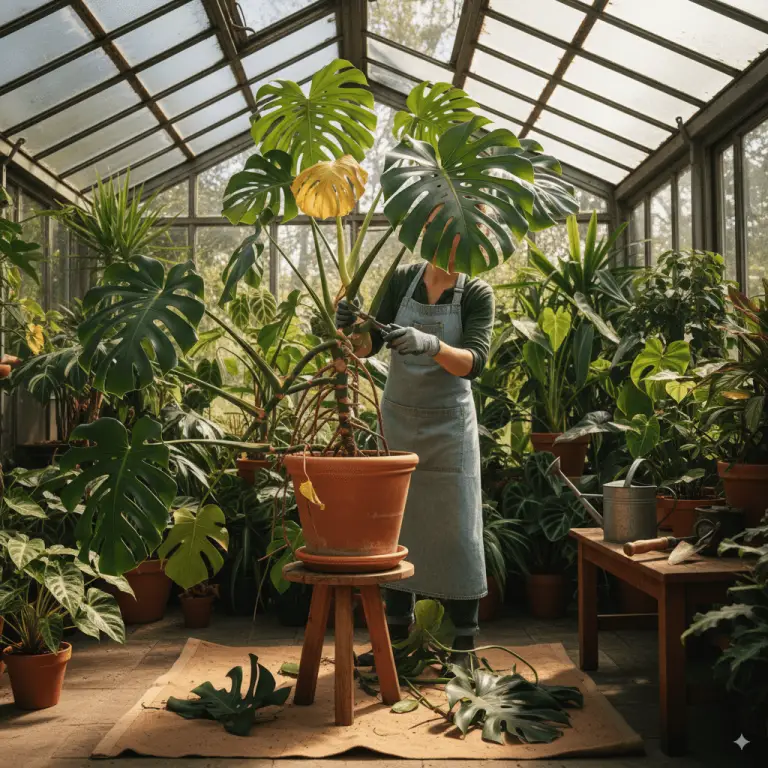
Step 2: Prune Affected Leaves with Precision
You cannot heal a leaf that already has fungal spots. The goal is to remove the sources of spores to prevent further spread. This is the most important part of our fungal leaf spot monstera care guide.
- Sterilize Your Tools: Before you make a single cut, wipe the blades of your pruning shears or scissors with rubbing alcohol. This prevents you from accidentally spreading spores to healthy tissue. Sterilize the blades again between each cut.
- Remove Heavily Infected Leaves: If a leaf has multiple spots or looks generally unhealthy, it’s best to remove the entire leaf. Follow the leaf stalk (petiole) back to the main stem and make a clean cut.
- For Light Infections: If a large, beautiful leaf only has one or two small spots, you can choose to cut out just the affected area. Make sure to cut a small margin of healthy green tissue around the spot to ensure you’ve removed all the infected cells.
Be ruthless! It feels painful to cut up your plant, but it’s a necessary surgery to save its life. New leaves will grow.
Step 3: Apply a Treatment to All Remaining Leaves
After removing the visible infection, you need to treat the rest of the plant to kill any lingering, invisible spores. You have two main routes here: eco-friendly options or chemical fungicides.
- For a Natural Approach: A copper-based fungicide or a high-quality neem oil solution are excellent choices. Neem oil is my personal go-to for minor issues; it acts as both a fungicide and a mild pesticide. Mix it according to the product directions and spray the entire plant, making sure to cover the tops and undersides of all leaves and stems.
- For a Stronger Approach: If the infection is severe or persistent, a commercial broad-spectrum fungicide might be necessary. Look for a product designed for houseplants and follow the application instructions to the letter. Always spray in a well-ventilated area and wear protective gear if recommended.
Reapply your chosen treatment every 7-14 days for a few weeks to ensure the fungus is completely eradicated.
Sustainable Fungal Leaf Spot Monstera Prevention: Best Practices for Healthy Leaves
Treatment is only half the battle. The real secret to success is creating an environment where fungus can’t thrive in the first place. Adopting these sustainable fungal leaf spot monstera best practices will keep your plant robust and resilient.
Perfecting Your Watering Routine
This is the most critical preventative measure. Fungi need water to survive.
Instead of watering on a rigid schedule, check the soil first. Stick your finger two inches deep; if it feels dry, it’s time to water. I strongly recommend bottom watering. Place your pot in a tray of water for 20-30 minutes and let it soak up moisture from the bottom. This keeps the leaves completely dry and delivers water directly to the roots where it’s needed.
Improving Air Circulation
Stagnant air is a fungus’s best friend. Ensure there is good airflow around your Monstera. Avoid crowding it too closely with other plants. If your home is particularly stuffy, running a small, gentle fan in the room for a few hours a day can make a world of difference. This helps leaf surfaces dry quickly after any exposure to moisture.
Mastering Leaf Hygiene
Dust and debris on leaves can trap moisture and harbor fungal spores. Every few weeks, gently wipe down your Monstera’s leaves with a soft, damp cloth. This not only keeps your plant looking glossy and beautiful but also removes potential threats. If you must mist your plant to boost humidity, do it in the morning so the leaves have all day to dry fully.
Common Problems with Fungal Leaf Spot Monstera (And How to Avoid Them)
Even with the best care, you might run into a few hurdles. Here are some common problems and tips to navigate them.
- The Spots Keep Coming Back: If you’ve treated the plant but new spots appear, it means the underlying environmental conditions haven’t been fixed. Re-evaluate your watering, airflow, and humidity. This is the most frequent issue I see.
- The Fungus Spreads to Other Plants: This happens when you skip the isolation step. If you see spots on other plants, you must start the entire treatment process for each of them. Quarantine is non-negotiable!
- The Plant Looks Worse After Pruning: Don’t panic! It’s normal for a plant to look a bit sparse after a heavy pruning. As long as you’ve addressed the root cause of the fungus, you’re giving it the best chance to push out healthy, new growth. Be patient.
Frequently Asked Questions About Fungal Leaf Spot Monstera
Can fungal leaf spot kill my Monstera?
It’s very unlikely. While a severe, untreated infection can weaken a plant significantly and cause major leaf loss, it rarely kills an otherwise healthy Monstera. The key is to catch it early and act decisively.
How quickly does fungal leaf spot spread?
It depends on the conditions. In a warm, damp, and stagnant environment, it can spread quite quickly, with new spots appearing in a matter of days. In a drier, well-ventilated space, the spread will be much slower or may halt altogether.
Is it okay to mist a Monstera if it has fungal spots?
Absolutely not. Misting is one of the primary ways fungal issues start and spread. You are essentially creating the perfect wet surface for spores to germinate. Avoid misting entirely until your plant has been fungus-free for at least a month, and even then, consider alternatives like a humidifier for a more controlled humidity boost.
Can I reuse the soil after treating my Monstera for fungus?
It’s best not to. Fungal spores can live in the top layer of the soil. If you have a persistent case of leaf spot, repotting your Monstera into fresh, well-draining soil after treatment is an excellent final step to ensure a completely fresh start.
Your Monstera’s Bright, Spot-Free Future
Discovering fungal leaf spot on your Monstera can be disheartening, but it’s far from a death sentence. Think of it as a lesson from your plant. It’s telling you that it needs a slight adjustment in its environment to be its best self. One of the hidden benefits of fungal leaf spot monstera is that it forces us to become more observant and proactive plant parents.
By following the steps in this guide—Isolate, Prune, Treat, and Prevent—you have all the tools you need to conquer this common issue. You’re not just saving a few leaves; you’re learning the skills to cultivate a healthier, more resilient indoor garden.
Now, go grab your clean pruning shears with confidence. Your Monstera is counting on you, and you’ve got this. Happy gardening!

- Houseplants Outdoors – Your Ultimate Guide To Thriving Summer - January 6, 2026
- Easiest To Grow Vegetables – Your Ultimate Guide To A Bountiful, - January 6, 2026
- Easiest Thing To Grow In Garden – Your Ultimate Guide To Effortless - January 6, 2026